Free Synastry Chart Calculator for Two Birth Charts
Two birth charts, every aspect between them, free.
Synastry resultSample couple
Person A Sep 29, 1990, 08:30Person B Mar 14, 1988, 19:10
Two invented people, not real ones. Enter your own birth details above and press the button to replace this result.
38 aspects between the two charts: 15 harmonious and 23 challenging.
The two charts as threads
Person A on the left, person B on the right. Each thread joins a point of A to a point of B. Tap a thread or a planet to read it.
- Harmonious
- Challenging
- Thicker is tighter
- Conjunction
- Sextile
- Square
- Trine
- Opposition
How to read it
- Harmonious solid thread, round badge. The two planets ease each other.
- Challenging dashed thread, diamond badge. Friction that asks for effort.
- Thicker is tighter. The width of a thread shows how close the aspect is to exact.
- Conjunction
- Sextile
- Square
- Trine
- Opposition
14 tightest of 38 links
Tap a thread or a planet
The tightest link is A’s Mars trine B’s Moon, orb 0°13′. Tap it, or any planet, to read what it means.
Strongest links6 tightest
MarsATrineMoonB
Person A's Mars trine Person B's Moon brings a relaxed rhythm between initiative and the comfort that helps the other person unwind.
VenusAOppositionSunB
The pull is appealing and awkward: Person A's Venus opposite Person B's Sun can leave A admiring B while wanting a softer response.
AscendantASquareMarsB
A’s first impression in square with B’s drive and desire: the two pull in different directions, creating friction that pushes both people to act.
MarsATrineAscendantB
A’s drive and desire in trine with B’s first impression: the two flow together with little effort, which feels natural and easy to take for granted.
SunATrineMoonB
Person A's Sun trine Person B's Moon often helps B settle around A's self-assurance, with care and appreciation passing between them naturally.
SunAConjunctionAscendantB
A’s sense of self in conjunction with B’s first impression: the two sit side by side, so their qualities blend into one.
All aspects38 found
Every aspect found between the two charts, tightest first. Orb is the distance from the exact angle.
| No. | Person A | Aspect | Person B | Orb | Nature |
|---|---|---|---|---|---|
| 1 | MarsA | Harmonious | MoonB | 0°13′ | Harmonious |
| 2 | VenusA | Challenging | SunB | 2°28′ | Challenging |
| 3 | AscendantA | Challenging | MarsB | 0°36′ | Challenging |
| 4 | MarsA | Harmonious | AscendantB | 2°28′ | Harmonious |
| 5 | SunA | Harmonious | MoonB | 5°53′ | Harmonious |
| 6 | SunA | Harmonious | AscendantB | 3°12′ | Harmonious |
| 7 | MoonA | Harmonious | SunB | 4°38′ | Harmonious |
| 8 | AscendantA | Harmonious | MoonB | 3°31′ | Harmonious |
| 9 | MidheavenA | Harmonious | SunB | 3°33′ | Harmonious |
| 10 | JupiterA | Challenging | VenusB | 1°30′ | Challenging |
| 11 | SunA | Challenging | MidheavenB | 4°37′ | Challenging |
| 12 | MoonA | Challenging | JupiterB | 2°05′ | Challenging |
| 13 | MercuryA | Challenging | SunB | 5°19′ | Challenging |
| 14 | MercuryA | Harmonious | MarsB | 4°46′ | Harmonious |
| 15 | JupiterA | Harmonious | AscendantB | 0°59′ | Harmonious |
| 16 | JupiterA | Challenging | MoonB | 3°40′ | Challenging |
| 17 | SunA | Challenging | SaturnB | 3°50′ | Challenging |
| 18 | North NodeA | Challenging | VenusB | 4°02′ | Challenging |
| 19 | VenusA | Challenging | North NodeB | 4°05′ | Challenging |
| 20 | SaturnA | Challenging | MarsB | 4°10′ | Challenging |
| 21 | AscendantA | Challenging | MidheavenB | 4°46′ | Challenging |
| 22 | VenusA | Challenging | SaturnB | 4°51′ | Challenging |
| 23 | North NodeA | Harmonious | AscendantB | 3°30′ | Harmonious |
| 24 | MidheavenA | Harmonious | North NodeB | 1°56′ | Harmonious |
| 25 | North NodeA | Harmonious | MoonB | 6°11′ | Harmonious |
| 26 | PlutoA | Harmonious | MarsB | 1°34′ | Harmonious |
| 27 | NeptuneA | Harmonious | VenusB | 2°19′ | Harmonious |
| 28 | NeptuneA | Challenging | MarsB | 2°45′ | Challenging |
| 29 | MercuryA | Challenging | North NodeB | 3°43′ | Challenging |
| 30 | SunA | Challenging | NeptuneB | 4°13′ | Challenging |
| 31 | PlutoA | Challenging | MoonB | 4°28′ | Challenging |
| 32 | VenusA | Challenging | UranusB | 3°46′ | Challenging |
| 33 | UranusA | Harmonious | VenusB | 3°49′ | Harmonious |
| 34 | SunA | Challenging | UranusB | 4°55′ | Challenging |
| 35 | NeptuneA | Challenging | MidheavenB | 1°24′ | Challenging |
| 36 | NeptuneA | Challenging | AscendantB | 2°50′ | Challenging |
| 37 | UranusA | Challenging | AscendantB | 3°17′ | Challenging |
| 38 | North NodeA | Challenging | JupiterB | 4°07′ | Challenging |
The same pair as a wheelBi-wheel
Person A on the inner ring, person B on the outer ring, the tightest aspects as lines across the middle. Tap a planet or a line. The table under the wheel lists the positions it is drawn from.
- AInner ring: Person A
- BOuter ring: Person B
Tap a thread or a planet
The tightest link is A’s Mars trine B’s Moon, orb 0°13′. Tap it, or any planet, to read what it means.
Positions as a table
| Point | A A | B B |
|---|---|---|
| Sun | Lib 5°47′ | Pis 24°38′ |
| Moon | Cap 29°16′ | Aqu 11°39′ |
| Mercury | Vir 19°19′ | Aqu 28°12′ |
| Venus | Vir 27°06′ | Tau 9°30′ |
| Mars | Gem 11°26′ | Cap 14°34′ |
| Jupiter | Leo 8°00′ | Tau 1°21′ |
| Saturn | Cap 18°44′ | Cap 1°57′ |
| Uranus | Cap 5°42′ | Cap 0°52′ |
| Neptune | Cap 11°48′ | Cap 9°59′ |
| Pluto | Sco 16°07′ | Sco 12°20′ R |
| North Node | Aqu 5°28′ R | Pis 23°01′ |
| Ascendant | Lib 15°10′ | Lib 8°59′ |
| Midheaven | Can 21°05′ | Can 10°24′ |
An orb is the distance, in degrees and minutes, between an aspect and its exact angle. A tight orb is a strong contact; each aspect has its own largest orb.
A synastry chart calculator compares two birth charts and lists the links between them. This calculator is free, needs no sign-up, and shows the chart without assigning a compatibility score.
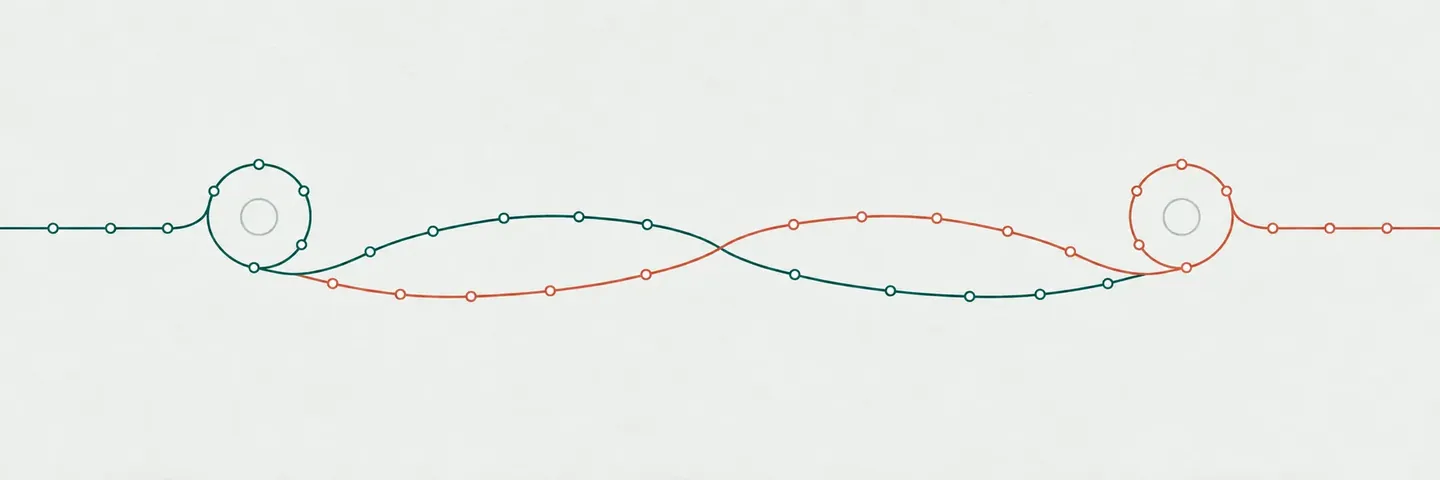
How the Calculator Works
Synastry is a comparison of two birth charts that shows how their planetary positions relate. For Person A and Person B, enter an optional first name, date, time, or select "I do not know the time," then enter a place found as you type. The calculator works out both charts and lays them over each other. Planet positions are tropical. Planet positions agree with NASA JPL Horizons within about 0.03 degrees for dates from 1900 to 2100.
What the Result Shows
The result starts with the two charts drawn as one figure, then shows the six strongest links. Each line names both planets and whose they are, the aspect, orb, harmonious or challenging label, and a plain description. Next come counts of harmonious and challenging contacts, followed by the full table of aspects between the charts. House overlays show where each person's planets fall in the other's chart, in both directions, and a link opens the composite chart for the same two people.
The calculator gives no percentage or compatibility score because a chart has none. A contact counts only when at least one point is the Sun, Moon, Mercury, Venus, Mars, Ascendant, Midheaven or north node. Contacts between two slow planets are left out because people born in the same years share them, so they say nothing about a couple. Harmonious and challenging labels describe different kinds of contact, not a verdict on the relationship.
When a Birth Time Is Unknown
When a birth time is unknown, that person's chart is cast for noon. Their Ascendant, Midheaven and houses are not shown, but the other planetary positions and contacts remain available. A contact involving a fast point that does not hold at 00:00, noon and 23:59 is marked "depends on the hour." The other person's known birth time still supplies that person's chart details.
Birth Details and Privacy
Nothing needs to be signed up for. Birth details are not stored or logged. The place is searched in the visitor's own browser, and the place name is never sent. The date, time, and place coordinates and time zone go only to the calculator's server to work out the chart; no third party receives them. An optional first name is a screen label and is never sent. A result link is made only when the visitor copies it.
Questions
What aspects does the synastry chart calculator use?
It uses conjunction, sextile, square, trine and opposition. The calculator labels sextiles and trines harmonious, and squares and oppositions challenging. A conjunction can receive either label, depending on the planets involved.
How does the calculator decide which links are strongest?
It compares each contact's orb, the gap from the exact angle. A smaller orb means a closer, stronger link. The allowed orb depends on the two bodies, and a sextile has a narrower allowance than the other listed aspects.
Which house system does the calculator use?
It uses Placidus houses, with Porphyry houses for places too far north or south for Placidus. House overlays depend on birth times because they use the houses in each person's chart.
Can I use the calculator on my phone?
Yes. The calculator fits a phone screen, so the birth details and chart can be viewed on a mobile device. The result includes the same chart information and sections as on a larger screen.
Can I share the result with someone?
A link to the result is created only when you copy it. This gives you control over whether to share the chart, and an optional first name remains a screen label rather than part of the link's submitted birth details.